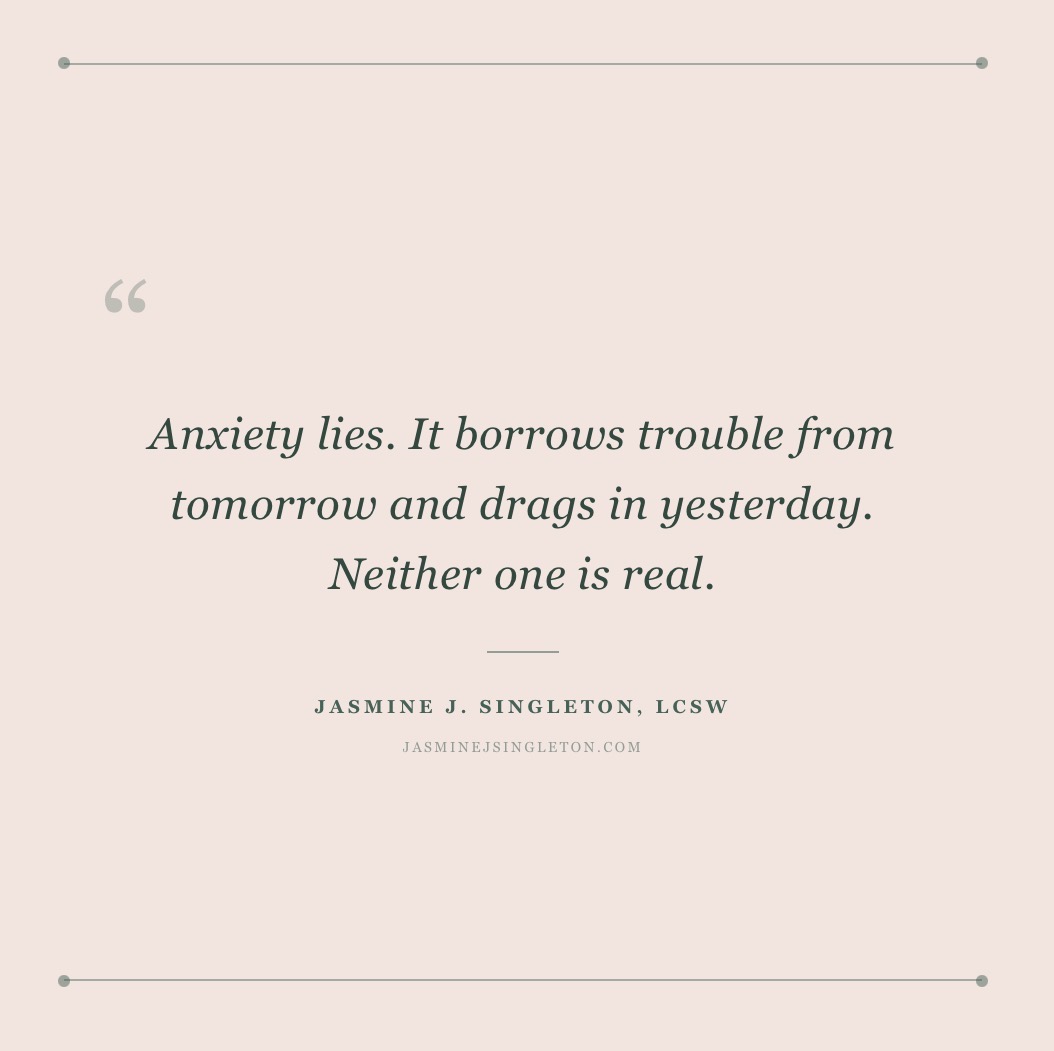
Let me say something before we even get into scripture. If you are reading this while your mind is already running through tomorrow’s to-do list, or replaying a conversation from last week, or bracing for something that hasn’t happened yet, I see you. And I want you to take one slow breath before we go any further.
Okay. Now let’s talk.
Anxiety is one of the most common things women come to me with in the therapy room. And for Black women specifically, it often arrives wearing a disguise. It looks like being on top of everything. It looks like handling it. It looks like strength. But underneath all of that doing, there is often a woman who has not felt truly still, truly safe, or truly present in a very long time.
Faith is something many of us were handed early. And for a lot of us, it has been a lifeline. But sometimes the very scriptures meant to bring comfort get used in ways that leave us feeling like anxiety is a spiritual failure. Like if we just prayed harder, trusted more, or quoted the right verse, we would finally stop feeling this way.
So I want to look at what the Bible actually says. Not as a checklist. Not as a correction. But as an invitation.
The Verse Everyone Quotes and What It Really Means
Philippians 4:6 is probably the most referenced scripture when it comes to anxiety. “Do not be anxious about anything, but in every situation, by prayer and petition, with thanksgiving, present your requests to God.”
On the surface, it can sound like a command. Like a spiritual to-do item. Stop being anxious. Just pray. Done.
But Paul wrote those words from prison. He was not writing from a comfortable place of ease. He was writing from a place of genuine uncertainty, and yet he had found something that anchored him. He wasn’t dismissing the hard feelings. He was pointing to a practice of prayer, gratitude, and bringing your whole self to God that creates a pathway through those hard feelings.
The verse that follows is the part we don’t quote as often: “And the peace of God, which transcends all understanding, will guard your hearts and your minds in Christ Jesus.”
Guard. Not erase. Not shame. Guard.
God is not asking you to never feel anxious. He is offering to stand watch over the places inside you that feel the most vulnerable.
Yesterday Is Gone. Tomorrow Isn’t Here Yet. So Where Are You?
One of the most profound things Jesus ever said about anxiety is found in Matthew 6:34: “Therefore do not worry about tomorrow, for tomorrow will worry about itself. Each day has enough trouble of its own.”
Read that again slowly.
Tomorrow will take care of itself. Yesterday is already done. The only moment that is actually real, the only ground you are standing on right now, is this one.
Anxiety almost always lives outside of the present. It either drags us back into what already happened, the conversation that went sideways, the decision we second-guess, the wound that never fully healed, or it pulls us forward into something that hasn’t arrived yet and may never arrive the way we’re imagining it.
What would it feel like to just be here? Not to fix anything. Not to figure anything out. Just to be in the actual moment you are living right now?
This is not a new concept that came from a wellness podcast. This is ancient wisdom. Scripture has always known that the present moment is where God meets us. “I AM,” God tells Moses in Exodus 3:14. Not “I was.” Not “I will be.” I AM. Present tense. Always.
When we are anxious, we are often living everywhere except where God already is, right here, right now, with us.
The Weight Black Women Carry Into Their Worry
Anxiety does not show up the same way for every woman. And for Black women, there are layers that deserve to be named directly.
There is the everyday anxiety of managing households, raising children, and showing up at work while navigating spaces that were not always built with you in mind. There is the particular exhaustion of code-switching, of being one version of yourself in one room and another version in the next, never fully at rest in either place. There is racial stress that accumulates quietly in the body, the kind that doesn’t just disappear at the end of the workday.
And then there is the anxiety that comes from never having been given permission to need help. From being raised to be strong. From being praised every time you held it together and left alone every time you were falling apart. When your resilience becomes the expectation, there is no safe place to put your worry down.
But here is what I know to be true, both as a therapist and as a woman of faith: carrying everything was never the assignment. Strength was never meant to mean silence. And God has always been more interested in your honesty than your performance.
Psalm 55:22 says, “Cast your cares on the Lord and he will sustain you.” Cast them. Not manage them perfectly. Not figure them out first. Cast them like something you’re releasing from your hands because they were never yours to hold alone.
What It Means to Be Grounded
Grounding is a word that shows up in both therapy and scripture, and I don’t think that’s a coincidence.
In clinical terms, grounding means bringing yourself back into your body and into the present moment when anxiety has pulled you out of it. It is one of the most powerful tools we have for managing anxious thoughts and nervous system dysregulation.
In spiritual terms, being grounded means being rooted in something that doesn’t move. Psalm 46:10 says, “Be still and know that I am God.” That stillness is not passive. It is an active choice to stop striving, stop spinning, and let yourself be held by something greater than what is worrying you.
Both are true at the same time. And both take practice.
Ways to Find Your Ground Starting Today
There is no one path back to yourself. What grounds one woman may not ground another. So I want to offer you options, because you know yourself better than any article does.
Through Faith
Prayer does not have to be formal. It can be as simple as sitting quietly and saying, “I don’t know how to handle this, and I need you.” Scripture can be a grounding tool too, not something you recite to make the anxiety stop, but something you sit with until the truth of it begins to settle in your body. Try writing out Psalm 23 in your own words. Or spend five minutes with just one phrase from scripture and let it breathe.
Through Your Body
Anxiety lives in the nervous system, not just the mind. One of the fastest ways to shift your state is through your breath. Try inhaling for four counts, holding for four, and exhaling for six. Do that three times and notice what changes. You can also try placing both feet flat on the floor, pressing them down deliberately, and naming five things you can see around you right now. These are not tricks. They are ways of telling your body that you are safe, you are here, and this moment is manageable.
Through Connection
You were not designed for isolation. One of the quietest lies anxiety tells is that you are the only one who feels this way, or that no one would understand, or that sharing it would be too much for someone else to hold. Find one person, not someone who will fix it but someone who will sit with it, and let yourself be a little more honest than usual. Community is one of God’s oldest designs for healing.
Through Professional Support
Therapy is not a sign that your faith isn’t enough. It is a resource, the same way a doctor is a resource. A therapist who understands your cultural background, your faith, and the specific weight that Black women carry can offer you tools and a space that few other places provide. You do not have to be in crisis to deserve support.
If you are looking for a therapist who gets it, these directories are a good place to start: Clinicians of Color (cliniciansofcolor.org), Melanin and Mental Health (melaninandmentalhealth.com), and Therapy for Black Girls (therapyforblackgirls.com).
And if you are located in Texas or New Mexico, I would love to connect with you personally. You are welcome to reach out to me directly for a free consultation at glwellnesscenter.com. You deserve care that sees you fully.
Through Small, Everyday Rituals
Grounding doesn’t always require a grand spiritual moment. Sometimes it’s stepping outside for five minutes in the morning before the day starts pulling at you. Sometimes it’s a cup of tea without your phone. Sometimes it’s putting on music that makes your shoulders drop. Sometimes it’s writing down three things that are true and good about your life right now, not to dismiss the hard things, but to remind yourself that the hard things are not the whole story.
You Are Allowed to Be Here
The present moment is not something to get through. It is where your life is actually happening. It is where God is. It is where you are, right now, in whatever state you arrived in.
Yesterday is finished. It cannot be changed, and it does not get to define what this moment holds for you. Tomorrow is not yours to carry today. It will come with its own grace, its own provisions, its own set of things God has already worked out that you cannot see yet.
All you have to do right now is be here. Breathe. Feel the ground under your feet. Let yourself be held by a God who already knows everything you’re worried about and has not left.
You are not falling apart. You are a woman who is learning what it means to be still. And that is one of the most courageous things there is.
If you are in a season where anxiety feels heavier than manageable, please reach out for support. You can call or text 988 (the Suicide and Crisis Lifeline) at any time. You matter too much to stay silent.
Leave a Reply