Tag: Generational Trauma

  • When Staying Becomes Surviving: Anxious Attachment and Why We Hold On Longer Than We Should

    You were never meant to lose yourself trying to make someone stay. — Jasmine J. Singleton, LCSW

    There is a particular kind of exhaustion that comes from staying in something past the point where it was ever going to become what you needed it to be. Not the exhaustion of working hard toward something. The exhaustion of pouring into a space that keeps emptying out, and convincing yourself that if you just give a little more, love a little harder, or hold on a little longer, something will finally shift.

    Many women know this feeling. And for Black women especially, it often goes unnamed, because we have been taught that staying is strength, that enduring is love, and that leaving means we gave up.

    But what if the staying has less to do with the relationship, and more to do with a wound that has been there a lot longer than the person in front of us?

    The Weight We Were Already Carrying

    Women wear many hats simultaneously, and most of us manage to do it in a way that looks, from the outside, like we have it all together. We are the caregivers, the decision-makers, the ones who hold households and relationships and families in place. When a parent’s health begins to decline, it is often a daughter, or the women in the family, who step in first. When a household needs managing, it is often a woman who manages it. And when a relationship starts to unravel, it is often a woman who tries to hold it together.

    We are praised for this capacity. Called strong. Called resilient. And those words carry real weight, because the endurance they describe is real. But endurance is not the same as thriving. And staying is not the same as choosing.

    At some point, every woman has to ask herself — when does staying in something become staying beyond what I actually have left to give? When does loyalty to a relationship become a loss of yourself?

    What Most of Us Were Never Taught

    Here is something that does not get talked about enough. Most of us have never been taught to understand our own attachment styles, and most people would not even recognize that term if they heard it. Yet our attachment styles shape nearly everything about how we show up in our closest relationships. What we need from a partner, what triggers us, what we reach for when we feel afraid, and how long we are willing to stay in something that is hurting us.

    Attachment theory tells us that the way we bonded, or struggled to bond, with the adults who raised us creates a kind of emotional blueprint. That blueprint gets carried into every significant relationship we have as adults, often without us realizing it.

    If you grew up in an environment where you felt consistently safe, seen, and responded to, you likely developed what is called a secure attachment. You are able to trust your partner, communicate your needs without spiraling, and tolerate the natural distance that comes with conflict without it feeling catastrophic.

    But many of us did not grow up in that kind of environment. Some of us grew up in homes where love was inconsistent. Where a parent was emotionally present sometimes and completely unavailable other times. Where affection had to be earned, or where we learned early that expressing our needs led to rejection, punishment, or being dismissed altogether. Some of us experienced neglect that was never dramatic enough to be called abuse, but that quietly taught us that we were not quite worth the effort of showing up for.

    When that is what love looked like growing up, we do not arrive at adulthood with a clean slate. We arrive with patterns, coping strategies that made sense in childhood but do not serve us in adult relationships. And one of the most common of those patterns is anxious attachment.

    What Anxious Attachment Actually Looks Like

    Anxious attachment does not always announce itself clearly. It does not show up as a neon sign that says “I am afraid of being left.” It shows up in subtler, more exhausting ways.

    It looks like checking your phone one more time to see if he responded, even though you just checked it. It looks like replaying a conversation from last week, trying to figure out if you said something wrong and why he seemed distant. It looks like working overtime to manage his moods, anticipating his needs before he even names them, making yourself smaller so that there is less for him to push back against.

    It looks like staying. Long past the point where you know something is not right. Long past the point where your gut has been telling you something that your heart refuses to hear. Not because you cannot see the problems, but because the thought of losing the relationship activates something deep and old inside of you. Something that has nothing to do with this particular man, and everything to do with a fear that was installed in you long before he arrived.

    Anxious attachment is driven, at its core, by a fear of abandonment. Not just the surface-level fear of being alone, but a more primal terror that you are not enough to make someone stay. That if you let go, you will confirm something you have always been afraid was true about yourself. That love does not last. That people leave. That you are too much, or not enough, or somehow fundamentally difficult to love.

    And so the brain does what brains do under threat. It tries to problem-solve its way out of the fear. It says, maybe if I love him better, he will stop pulling away. Maybe if I stop asking for what I need, he will stop feeling suffocated. Maybe if I just hold on, this will become what I always hoped it would be.

    Why This Hits Black Women Differently

    For Black women, anxious attachment does not exist in isolation. It exists alongside a cultural narrative that has long insisted that we are not supposed to walk away from hard things. That staying through struggle love is loyalty. That when a man is not yet who you need him to be, it is your job to love him into becoming that person, and if you leave before he gets there, you did not love him correctly.

    We are told that having standards means we are difficult. That setting boundaries means we are masculine or aggressive or impossible to please. We are given a long list of unflattering labels for simply requiring that our love be reciprocated, and many of us internalize those labels early enough that we stop asking.

    The result is that anxious attachment in Black women can run especially deep. The fear of being called difficult is layered on top of the fear of abandonment, which is layered on top of a lifelong experience of having emotional needs dismissed or minimized. We do not just stay because of our attachment wounds. We stay because we have been told, in a hundred different ways, that asking for more is the problem.

    The Question Worth Sitting With

    Here is what I want you to consider. When you are staying in a relationship that is costing you your peace, your sense of self, your emotional stability, are you staying because the relationship is genuinely growing and worth holding on to? Or are you staying because leaving feels like proof of something you are terrified to confirm?

    Those are two very different reasons to stay. And only one of them is actually about the relationship.

    Recognizing the difference is not easy, especially when your nervous system has been wired since childhood to read distance as danger and conflict as an incoming abandonment. But that recognition is where something begins to shift. Not the relationship necessarily, but you. Your understanding of what you actually need, what you deserve to have, and how long you are willing to bargain with yourself before you are willing to choose you.

    You were never meant to lose yourself trying to make someone stay. And the fear that has been driving some of your choices is not a character flaw — it is a wound that has a name, a history, and a path toward healing.

    That path is worth taking.

    If this resonated with you

    Share It With Someone Who Needs It

  • You Are Not Who You Were — And That’s the Point

    You Are Not Who You Were — And That’s the Point

    On releasing the guilt of growth and refusing to be held hostage to a past that no longer belongs to you

    Have you ever noticed how quickly someone reaches for the phrase “I remember when” the moment your life starts to look different than it once did?

    It almost sounds gentle at first. Nostalgic, even. But spend a little more time sitting with it and you begin to feel what it actually is—a leash. A quiet, calculated pull back toward a version of you that was easier for them to be around. More familiar. Less threatening. Less free.

    “I remember when you used to…” is rarely about honoring your story. It is about keeping you tethered to it.

    The Unspoken Expectation Hidden Inside That Phrase

    When someone says “I remember when” or “you used to think that” or “that’s not like you,” they are rarely trying to celebrate how far you have come. What they are really saying, underneath the softness of it, is: come back. Come back to the version of you I understood. The one who didn’t make me question my own choices. The one who stayed where I could see her.

    Because here is the truth that nobody wants to say out loud: your growth can feel like an indictment to the people around you who have not moved. When you begin to make different decisions, set new boundaries, choose better relationships, or simply refuse to carry what you once carried without a word, it holds up a mirror. And sometimes the people closest to you do not like what they see in it.

    So they reach for the “I remember when.” They remind you of your mistakes. They reference the version of yourself you worked the hardest to leave behind. Not because they are trying to hurt you, though sometimes they are. But because your evolution is inconvenient to their comfort.

    Your growth is not a betrayal of who you were. It is a testimony to everything you survived.

    The Disguise That Insults Wear

    There is a specific kind of cruelty that presents itself as humor. The joke at your expense that is supposed to be taken lightly. The “remember when you did that” delivered with a laugh so that any pushback on your part makes you the one who is too sensitive, too serious, can’t take a joke.

    Pay attention to the people in your life who use your past as a punchline. Who bring up your lowest moments when the room is full. Who remind you, in front of others, of who you used to be with just enough of a smile to make it socially acceptable.

    That is not love. That is a power move.

    It is designed to keep you small enough to need them and familiar enough not to threaten them. It is an insult wearing the outfit of inside-joke intimacy. And you are allowed to name it, even if naming it makes them uncomfortable.

    You Are Not Required to Live in the Past

    Here is what is true: you have made choices you would take back. We all have. Decisions that we replayed a hundred times, that we wished we could reach back and undo. Roads that felt right and ended badly. Relationships we stayed in too long. Versions of ourselves that we are not entirely proud of.

    But you are the one who lived through those moments. You were there for all of it. The shame, the confusion, the regret, and the slow, hard climb out of it. You do not need anyone to remind you of what you already carry.

    You cannot time travel. What you can do is refuse to let someone else use your past as a permanent residence. Your mistakes are part of your story. They are not the whole of it. And they do not define what you are allowed to become.

    You have permission to want better and to actually pursue it. Full stop.

    On Being Held Emotionally Hostage

    There is a particular kind of exhaustion that comes from being around people who are still attached to a version of you that no longer exists. Who talk about you in the present tense as if you are still the same person you were five years ago. Who resist every sign of your change because somewhere in their own story, your staying the same served a purpose.

    These people are not always strangers. They are often people we love. Family members who remember our worst chapters. Old friends who bonded with us over shared suffering. Partners who preferred us when we were a little more uncertain, a little less sure of ourselves.

    And the thing is, letting go of their version of you is not the same as letting go of them. It is possible to love someone and also refuse to be defined by their memory of who you were. It is possible to hold the relationship while releasing their grip on your narrative.

    You are allowed to outgrow the version of yourself that someone else still needs you to be.

    Standing in Your Truth in the Present Moment

    The work is not about defending your growth to anyone who challenges it. You do not owe anyone a detailed explanation of how you got from there to here, or why you are no longer willing to fit into the container they built for you.

    The work is about standing firmly inside of who you actually are right now, today, in this present version of your life, without apologizing for the distance between that and where you started.

    Setting a boundary with someone who holds your past over you is not cruelty. It is clarity. It is saying — I know who I was. I know what I have lived. And I have also decided what I am no longer willing to carry.

    That is not arrogance. That is self-preservation. That is healing made visible.

    Release the Guilt. Keep the Growth.

    Guilt is one of the most effective tools people use to keep us frozen. And when it is attached to our past, to who we once were, the mistakes we made, the ways we fell short, it can feel almost righteous to hold onto it. As if carrying it is some form of penance.

    But guilt that has expired its usefulness is just weight. And you have already proven, more times than anyone has given you credit for, that you know how to carry weight. What you are learning now is that you do not have to.

    You do not have to live in the shadows of who you were. You do not have to keep apologizing for the choices you made with what you knew at the time. You do not have to remain a permanent exhibit of your most painful chapters for the comfort of people who never had to live them.

    You are allowed to close that chapter, not because it never happened, but because it is finished. And you have not just survived it. You have grown past it.

    A Note for the Woman Reading This

    If someone has been using “I remember when” to keep you small, this is your reminder that you are not required to stay.

    If someone has been holding your past over your head like a ledger of everything you owe them, this is your reminder that the debt has been paid.

    If you have been carrying guilt about who you were before you knew better, this is your permission to put it down.

    You are not the woman you were. You are the woman you chose to become. And that choice — the decision to learn, to evolve, to build a life that reflects who you actually are now — is one of the most courageous things a person can do.

    Stand in that. Unapologetically.


    If this resonated with you and you are navigating the emotional weight of growth, relationships, or releasing the past, support is available. If you are in Texas or New Mexico, visit glwellnesscenter.com for a free consultation. Wherever you are, you deserve the space to become who you were always meant to be.

    If this resonated with you

    Share It With Someone Who Needs It

  • Why “Strong Black Woman” Is a Trauma Response, Not a Compliment

    Why “Strong Black Woman” Is a Trauma Response, Not a Compliment

    I want to tell you about one of the lowest seasons of my life. Not because I enjoy revisiting it, but because I know someone reading this has lived a version of it too, and I want you to feel less alone in it.

    Where This Strength Actually Comes From

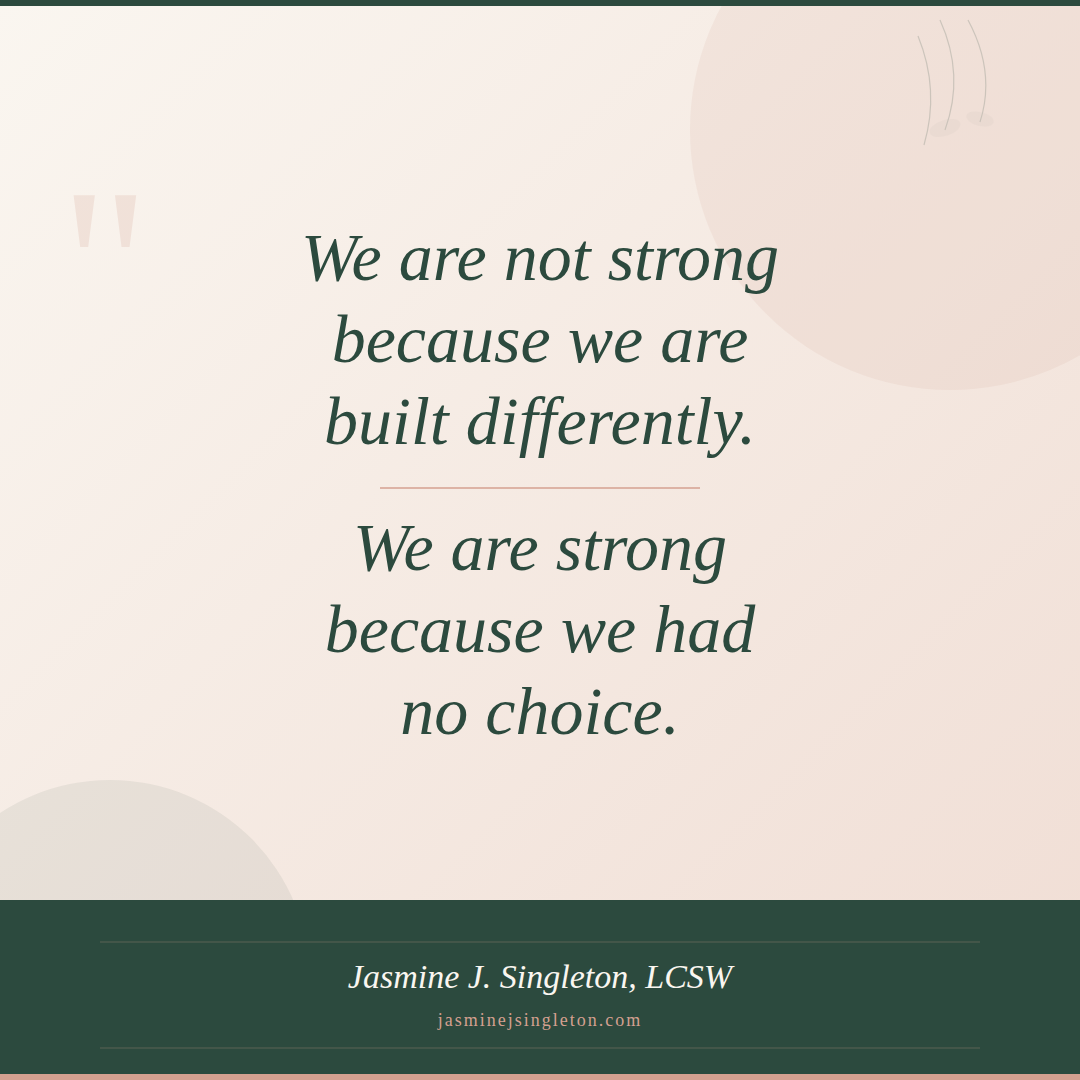
    Black women did not choose this narrative of strength. It was placed on us, generation after generation, born out of circumstances that left us no other option. Survival looked like strength. And strength became our identity, whether we wanted it or not.

    We work ourselves to exhaustion, holding down careers while raising children, many of us doing it alone. We navigate financial stress, emotional labor, and the mental weight of moving through spaces not designed with us in mind. We carry all of this quietly, because speaking up means being labeled difficult or angry. Because asking for help is treated as weakness.

    Strength was never supposed to mean silence. And endurance was never supposed to mean going without.

    What It Has Done to Our Relationships

    When a woman is viewed as unbreakable, the natural instinct to protect her gets diminished. The narrative that positions us as strong above all else has quietly communicated to the men in our lives that we do not need what other women need. That our needs are optional.

    We were never meant to be everyone’s backbone. We were meant to be someone’s partner, someone’s equal, someone who gets to be held too.

    Let Us Talk About Our Femininity

    I am a soft-spoken woman. Extremely feminine. I have an unreasonable fear of lizards. I do not believe in taking out the trash when there is a man around. I love being in my femininity in every gentle, girly, tender way that word means. And yet, the story told about me has never led with any of that. It leads with how much I have endured. How much I have survived.

    Pain and perseverance have become the metrics by which Black womanhood is measured, while softness and femininity are treated as traits that belong to other women.

    We do not want to be statues. We want to be women. Fully, completely, softly, beautifully human women.

    The Narrative Has to Change

    It means the people who love us have to stop using our past resilience as a reason not to show up for us now. It means that we, as Black women, have to give ourselves permission to stop performing invincibility for people who have grown comfortable with our strength at the expense of our wellbeing.

    You are allowed to need things. You are allowed to not be okay. The myth of the Strong Black Woman has had its season. It is time to tell a fuller story.

    If this resonated with you

    Share It With Someone Who Needs It